
GIVE THANKS
A four-week sermon series on gratitude, November 2026. Each week has the sermon slide, a summary of the message, and a discussion guide for small groups.


Week 1 of 4
Give Thanks For Jesus
Discussion guide
Give Thanks: For Jesus. Jesus is on the road to Jerusalem and the cross when ten men with a skin disease call to him from a distance. Under the law they lived outside the village and had to keep away from everyone else (Leviticus 13:45–46). Jesus heals all ten. Only one comes back. In the Bible, giving thanks is more than a feeling of appreciation; it is turning back to the Giver and telling out loud what he has done.
Pray: Ask God to open your eyes to the gifts you have received and to turn your hearts back to the Giver.
Read Luke 17:11–19 (ESV)
11On the way to Jerusalem he was passing along between Samaria and Galilee. 12And as he entered a village, he was met by ten lepers, who stood at a distance 13and lifted up their voices, saying, “Jesus, Master, have mercy on us.” 14When he saw them he said to them, “Go and show yourselves to the priests.” And as they went they were cleansed. 15Then one of them, when he saw that he was healed, turned back, praising God with a loud voice; 16and he fell on his face at Jesus’ feet, giving him thanks. Now he was a Samaritan. 17Then Jesus answered, “Were not ten cleansed? Where are the nine? 18Was no one found to return and give praise to God except this foreigner?” 19And he said to him, “Rise and go your way; your faith has made you well.”
- Discuss your week. What is one specific thing God has given you this past week that you are thankful for?
- All ten lived “at a distance” (v. 12). What did their disease cost them besides their health? Who lives at a distance from people today, and what keeps them there?
- Jesus healed them “as they went,” before they ever reached the priests (v. 14). What did the ten have to trust in order to start walking? Where might God be asking you to take a step before you see the result?
- All ten were healed, but only one “saw that he was healed” and turned back (v. 15). What is the difference between receiving a gift and seeing it? What keeps you from noticing what God has done for you?
- He praised God “with a loud voice” and fell at Jesus’ feet. Why do you think Scripture so often shows thanksgiving as something spoken and public rather than a private feeling? Is your gratitude mostly felt, or mostly said?
- He gave thanks to Jesus (v. 16), and Jesus calls it giving praise to God (v. 18). What does that tell us about who Jesus is? How should it shape where our thanks goes?
- Read Luke 17:7–10, just before this story. The nine did exactly what Jesus told them to do. Why does he still ask, “Where are the nine?” What does it look like to obey God faithfully and still never come back to him in worship?
- The ESV notes that “made you well” in verse 19 can also be translated “saved you.” All ten were cleansed. What did this one man receive that the other nine missed?
- Name one specific way God has rescued, provided for, or forgiven you. Who in your life has never heard you tell that story? What would it look like this week to give thanks to Jesus out loud, where someone else can hear?
Pray:
- Thank God for specific mercies he has shown your group this week.
- Ask for eyes to see his gifts and hearts that turn back to the Giver.
- Pray for courage to tell someone what Jesus has done for you.
- Give thanks for Jesus, who welcomes outsiders and makes us whole.
Sermon summary
Why Gratitude Matters
People often say you can't be grateful and complain at the same time, and Scripture agrees. It sets thanksgiving against anxiety (Phil 4:6) and grumbling (Phil 2:14), and it shows Israel complaining while manna lay on the ground every morning (Num 11:4–6). Biblical gratitude begins with knowing who Jesus is, the Savior and Christ the Lord (Luke 2:11) who touches the unclean (Luke 5:13), and what he has done: he suffered outside the gate to make his people holy, so we offer God a sacrifice of praise (Heb 13:12, 15).
The Cry (vv. 11–14)
Ten men with a skin disease lived "at a distance," cut off from their community by the law (Lev 13:45–46). They cried out, "Jesus, Master, have mercy on us," and Jesus sent them to the priests. They were cleansed as they went, trusting his word before they saw any change.
The Return: Give Thanks (vv. 15–16)
All ten were healed, but only one saw it and turned back. He praised God with a loud voice and fell at Jesus' feet giving thanks, and Jesus counts that thanks as giving glory to God (v. 18). Luke adds that the man was a Samaritan. The outsider knew he had received what he did not deserve.
The Nine (vv. 17–19)
The nine did what Jesus told them and received what he gave, but they never came back to Jesus himself. Just before this story, Jesus taught that our obedience never puts God in our debt (vv. 7–10). To the one who returned, Jesus said, "Your faith has made you well," words that can also be translated "your faith has saved you." All ten were cleansed; one went home made whole.
Living It Out
Notice one specific mercy God has shown you this week. Tell someone what Jesus has done for you, out loud. And don't let the gift keep you from the Giver: come back to Jesus.
Week 2 of 4
Give Thanks With the Church
Discussion guide
Give Thanks: With the Church. Scripture calls the church to give thanks together in prayer, in song, in daily life, in our speech, and at our tables. But thanksgiving alone proves nothing about the heart. In 1 Timothy 2, Paul places thanksgiving inside the church’s prayers “for all people,” even rulers who were no friends of the church. He grounds it in God’s desire that all people be saved and in the one Mediator, Christ Jesus, who gave himself as a ransom for all.
Pray: Ask God to soften your heart toward people you find hard to pray for, and to make your group’s thanksgiving humble and outward.
Read 1 Timothy 2:1–6 (ESV)
1First of all, then, I urge that supplications, prayers, intercessions, and thanksgivings be made for all people, 2for kings and all who are in high positions, that we may lead a peaceful and quiet life, godly and dignified in every way. 3This is good, and it is pleasing in the sight of God our Savior, 4who desires all people to be saved and to come to the knowledge of the truth. 5For there is one God, and there is one mediator between God and men, the man Christ Jesus, 6who gave himself as a ransom for all, which is the testimony given at the proper time.
- Discuss your week. Last week we talked about turning back to give thanks to Jesus out loud. Did you tell someone what Jesus has done for you? How did it go?
- Scripture calls the church to give thanks in prayer, song, daily life, speech, and at meals. Which of these comes most naturally to you? Which is mostly missing, and why do you think that is?
- Paul places thanksgiving right beside requests made “for all people” (v. 1). A few verses earlier he calls himself the “foremost” of sinners (1:15). How does remembering what you were saved from change who you are willing to pray for? Is there a person or group you have quietly decided is too far from Jesus?
- Paul wrote verse 2 while Nero ruled Rome. Why is giving thanks for leaders often harder than praying for them? What would it look like to thank God for a leader you disagree with, without pretending to approve of everything they do?
- Paul connects prayer for leaders to “a peaceful and quiet life, godly and dignified” (v. 2). Is that peace mainly about our circumstances or about our posture? How has the way you talk about leaders affected your own peace?
- The word “all” keeps repeating in this passage (vv. 1, 2, 4, 6). If God desires all people to be saved (v. 4), what does it reveal when our prayers stay inside our own circle?
- There is one God and one Mediator, “the man Christ Jesus,” who gave himself as a ransom for all (vv. 5–6). How does the fact that everyone comes to God the same way remove both our pride and our contempt for others?
- Name one leader and one person far from God that you will give thanks for and pray for by name this week. How can your group help you follow through?
Pray:
- Give thanks for leaders in our city, state, and nation by name.
- Pray for peace and for the church to live godly and dignified lives.
- Pray for the people far from God named in your group.
- Give thanks for Jesus, the one Mediator who gave himself as a ransom for all.
Sermon summary
The Church Gives Thanks
Scripture calls believers to give thanks together: in prayer (1 Tim 2:1; 2 Cor 1:11; Col 4:2), in song (Col 3:16; Eph 5:19–20; Ps 100:4), in daily life (Col 3:15, 17; 1 Thess 5:18), in our speech (Eph 5:4; Heb 13:15; Phil 2:14), and at our meals (1 Tim 4:4–5; 1 Cor 10:30). 1 Timothy 2 shows what that thanksgiving looks like.
A Heart for All (v. 1)
Paul urges that thanksgivings be offered alongside prayers "for all people." This is the same Paul who called himself the foremost of the sinners Christ came to save (1:15). No one is too far from Jesus to be saved by Jesus, so we pray for others and give thanks for them, unlike the Pharisee who thanked God that he was "not like other men" (Luke 18:11).
The Good Life (v. 2)
We pray and give thanks for "kings and all who are in high positions" so that we may lead "a peaceful and quiet life, godly and dignified in every way." Paul wrote this while Nero ruled Rome. Praying and giving thanks for leaders is a path to peace for the church, just as God told Israel in exile to seek the welfare of the city and pray for it (Jer 29:7).
The Desire of God (vv. 3–4)
This kind of prayer pleases God, who "desires all people to be saved and to come to the knowledge of the truth." The word "all" runs through the whole passage (vv. 1, 2, 4, 6). When we pray for all people, our prayers line up with God's own heart (Ezek 33:11; 2 Pet 3:9).
In Christ Alone (vv. 5–7)
There is one God and one mediator between God and people, the man Christ Jesus, who gave himself as a ransom for all (compare Mark 10:45). Everyone comes to God the same way, through Jesus alone (Acts 4:12). Paul was sent to carry that message to the nations, and the church carries it still.
Together
Paul goes on to call believers to pray "without anger or quarreling" (v. 8). Thanksgiving alone proves nothing about the heart. This week, give thanks for one leader by name, and pray by name for one person who is far from God.
Week 3 of 4
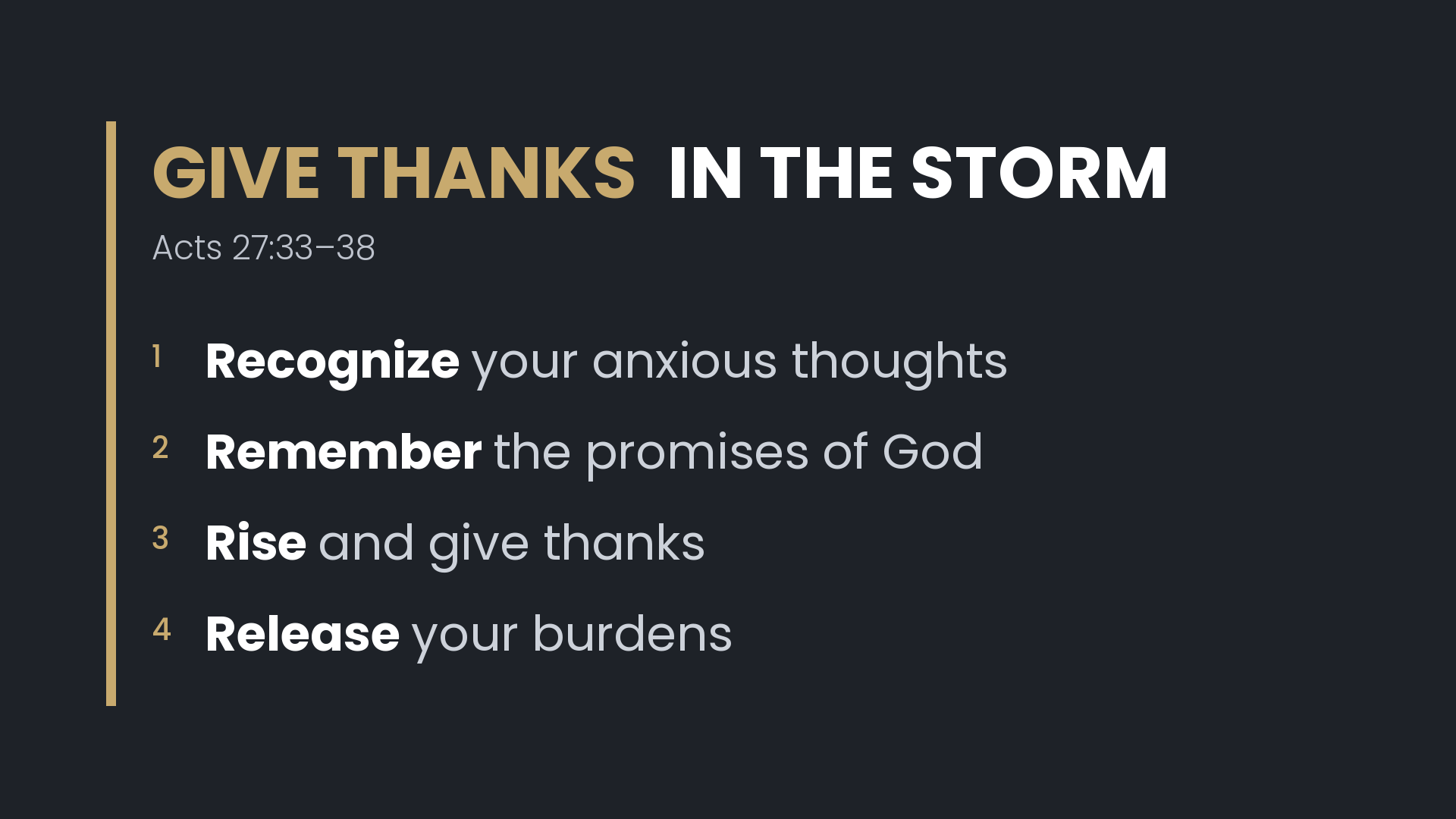
Give Thanks In the Storm
Discussion guide
Give Thanks: In the Storm. From the day Jesus called him, Paul was told how much he would suffer for the name of Christ (Acts 9:16). By Acts 27 he is a prisoner on a grain ship caught in a storm that has raged for two weeks, and every person on board has given up hope (27:20). But God had already made a promise: not one life would be lost (27:22–24). Before the storm ends and before land is in sight, Paul takes bread and gives thanks to God in front of 276 frightened people.
Pray: Ask God to help each person name the storm they are in and to trust what he has already promised.
Read Acts 27:33–38 (ESV)
33As day was about to dawn, Paul urged them all to take some food, saying, “Today is the fourteenth day that you have continued in suspense and without food, having taken nothing. 34Therefore I urge you to take some food. For it will give you strength, for not a hair is to perish from the head of any of you.” 35And when he had said these things, he took bread, and giving thanks to God in the presence of all he broke it and began to eat. 36Then they all were encouraged and ate some food themselves. 37(We were in all 276 persons in the ship.) 38And when they had eaten enough, they lightened the ship, throwing out the wheat into the sea.
- Discuss your week. Last week we committed to give thanks for one leader and pray for one person far from God by name. How did it go?
- Paul was told from the start how much he would suffer (Acts 9:16), and he had already been shipwrecked three times before this voyage (2 Corinthians 11:25). How does knowing hardship is expected change the way you face it? Does it make thanksgiving easier or harder?
- The people on the ship spent fourteen days “in suspense” (v. 33), so anxious they stopped eating. What does anxiety tend to take from you? What are you most prone to worry about?
- God had already promised that no one would die (vv. 22–24, 34), yet they spent two weeks in fear. Which of your worries are about things God has already spoken to? Read Hebrews 13:5, Romans 8:1, and Romans 8:38–39. Which promise do you most need to believe this week?
- God promised to save the lives on board, but not the ship (v. 22). Why is it important to know what God has promised and what he has not? How have you seen people get discouraged by expecting promises God never made?
- Paul gave thanks “in the presence of all” (v. 35) before the storm was over, and the people “were all encouraged” (v. 36). Why is thanksgiving before the rescue such a powerful witness? Who around you is watching how you respond to your storm?
- After they ate, they threw the wheat into the sea (v. 38), and earlier they cut away the lifeboat (vv. 30–32). God’s way forward often feels like a bigger problem. What might God be asking you to let go of that feels like your security?
- All the promises of God find their Yes in Jesus (2 Corinthians 1:20). What storm are you in right now, and what is one way you will give thanks to God in it this week, where someone else can see?
Pray:
- Pray for those in the group who are walking through storms right now, by name.
- Thank God for specific promises he has already made and kept.
- Ask for courage to give thanks before the rescue comes, in front of others.
- Give thanks for Jesus, in whom every promise of God is Yes.
Sermon summary
The Story So Far
From the day Jesus called him, Paul was told how much he would suffer for Christ's name (Acts 9:16). Before this voyage he had already been shipwrecked three times (2 Cor 11:25), and he knew imprisonment was ahead (Acts 20:22–24). But the Lord had promised, "You must testify also in Rome" (Acts 23:11). On the way, a violent storm left everyone on board without hope (27:20), until an angel told Paul that God had granted him the lives of all who sailed with him (27:24–25).
Recognize Your Anxious Thoughts (v. 33)
The storm had raged for two weeks with no sun or stars, and the crew had gone fourteen days "in suspense and without food." Anxiety takes our appetite, our sleep and our strength. Paul named it and urged them to eat.
Remember the Promises of God (v. 34)
"Not a hair is to perish from the head of any of you." With no stars to steer by, God's promise was the only fixed point they had, and they had spent two weeks afraid of an outcome God had already settled. Many of our worries are about things God has already spoken to. He will never leave us (Heb 13:5). There is no condemnation for those in Christ (Rom 8:1). Nothing can separate us from his love (Rom 8:38–39), and no one can snatch us from his hand (John 10:28). He knows our needs and supplies them (Matt 6:31–33; Phil 4:19). He provides a way through temptation (1 Cor 10:13), works all things for good (Rom 8:28), and will finish what he started in us (Phil 1:6). Death does not have the last word (John 11:25–26), and his church will stand (Matt 16:18). God promised the lives on board, not the ship (v. 22), so it matters to know what he has promised and what he has not.
Rise and Give Thanks (vv. 35–36)
Paul was a prisoner, not the captain, yet he stood up and led. He took bread and gave thanks to God in front of 276 people, most of whom did not know God, while the storm was still raging and the wreck was still ahead. His thanksgiving encouraged everyone, and they all ate. In a family, a small group or a workplace, someone has to be the first to give thanks in the middle of the storm. Later, safe on land, Paul again "thanked God and took courage" (28:15).
Release Your Burdens (v. 38)
They threw the wheat, the whole reason for the voyage, into the sea. They had already cut away the lifeboat (vv. 31–32), and soon the ship itself broke apart (v. 41). God's way forward often feels like a bigger problem, yet "all were brought safely to land" (v. 44).
Our Hope in Christ
All the promises of God find their Yes in Jesus (2 Cor 1:20). Jonah was thrown into a storm so that the sailors could live. Jesus, the greater Jonah (Matt 12:40–41), entered the storm of God's judgment so that we could be brought safely home.
Week 4 of 4
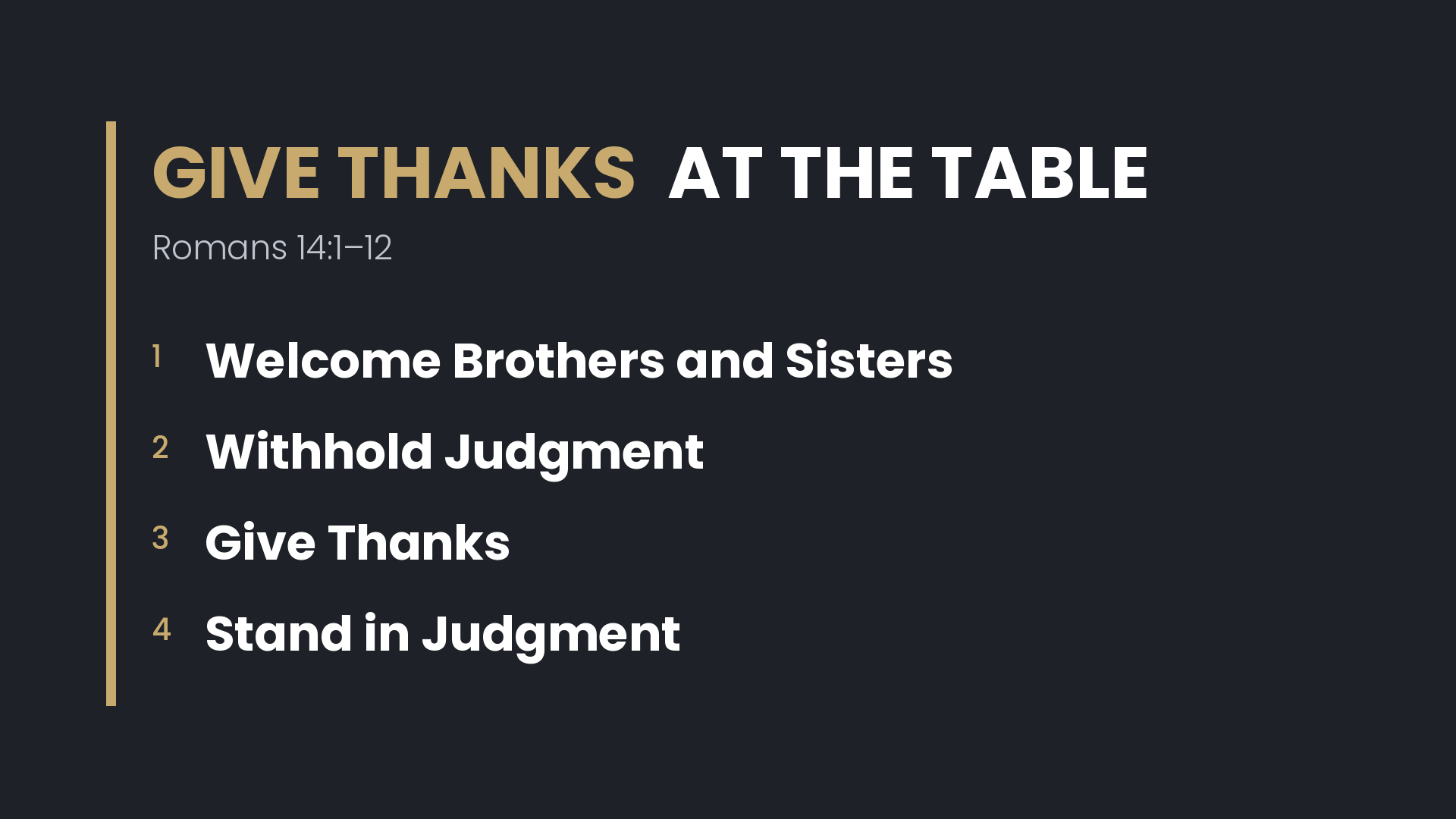
Give Thanks At the Table
Discussion guide
Give Thanks: At the Table. Romans 13 tells us that love is the fulfilling of the law and lists quarreling among the works of darkness. In Romans 14 Paul applies that love to the dinner table, where believers in Rome disagreed about food and special days. These were disputable matters, not questions of sin or the gospel. Paul calls the church to welcome one another, to stop judging and despising, and to remember that both sides give thanks to the same Lord, before whom we will all stand.
Pray: Ask God to show each person where they have been quick to judge or despise a fellow believer, and to make your group a place of welcome.
Read Romans 14:1–12 (ESV)
1As for the one who is weak in faith, welcome him, but not to quarrel over opinions. 2One person believes he may eat anything, while the weak person eats only vegetables. 3Let not the one who eats despise the one who abstains, and let not the one who abstains pass judgment on the one who eats, for God has welcomed him. 4Who are you to pass judgment on the servant of another? It is before his own master that he stands or falls. And he will be upheld, for the Lord is able to make him stand. 5One person esteems one day as better than another, while another esteems all days alike. Each one should be fully convinced in his own mind. 6The one who observes the day, observes it in honor of the Lord. The one who eats, eats in honor of the Lord, since he gives thanks to God, while the one who abstains, abstains in honor of the Lord and gives thanks to God. 7For none of us lives to himself, and none of us dies to himself. 8For if we live, we live to the Lord, and if we die, we die to the Lord. So then, whether we live or whether we die, we are the Lord’s. 9For to this end Christ died and lived again, that he might be Lord both of the dead and of the living. 10Why do you pass judgment on your brother? Or you, why do you despise your brother? For we will all stand before the judgment seat of God; 11for it is written, “As I live, says the Lord, every knee shall bow to me, and every tongue shall confess to God.” 12So then each of us will give an account of himself to God.
- Discuss your week. Last week we committed to name our storm and give thanks to God in it where someone else could see. How did it go?
- Just before this passage, Paul says love is the fulfilling of the law (13:8–10), and later he says that grieving a brother over food means “you are no longer walking in love” (14:15). How does seeing Romans 14 as love, not just tolerance, change the way you approach disagreements with other believers?
- Paul says to welcome the weak, “but not to quarrel over opinions” (v. 1), which could be translated “not for passing judgment on his thoughts.” What is the difference between welcoming someone and welcoming them so you can correct them? Why does Paul ground our welcome in God’s welcome (v. 3; 15:7)?
- The welcome Paul describes is unconditional for the fellow believer. What unspoken conditions do churches, or we personally, sometimes attach to welcome?
- Paul names two temptations (v. 3): those with more freedom tend to despise, and those with stricter convictions tend to judge. Which are you more prone to? What disputable matters today tempt Christians to do one or the other?
- Romans 14 is about disputable matters, not sin or the gospel (compare 1 Corinthians 5; Galatians 1:6–9). How do you tell the difference? What happens to a church when it gets that line wrong in either direction?
- In verse 6, the one who eats and the one who abstains both “give thanks to God.” How does thanking the same Lord change the way you see a believer who practices differently than you?
- “Each of us will give an account of himself to God” (v. 12). How does remembering that you will stand in judgment for yourself change the way you think about other people’s convictions?
- Who will be at your table this Thanksgiving that you disagree with? What is one specific way you can welcome them without passing judgment?
Pray:
- Confess places where we have despised or judged fellow believers over disputable matters.
- Pray for unity in our church and for welcome that reflects Christ’s welcome.
- Pray for peace and love around our Thanksgiving tables this week.
- Give thanks for Jesus, who died and lived again to be Lord of us all.
Sermon summary
The Context
Romans 13 says that love is the fulfilling of the law (13:8–10) and lists quarreling among the works of darkness (13:13). Romans 14 puts that love into practice at the table, where believers in Rome disagreed about food and special days. These were disputable matters, not questions of sin (1 Cor 5) or of the gospel itself (Gal 1).
Welcome Brothers and Sisters (vv. 1–3)
"Welcome him, but not to quarrel over opinions," or more literally, not to pass judgment on his thoughts. God has welcomed him (v. 3), so our welcome of a fellow believer has no conditions attached, just as Christ has welcomed us (15:7).
Withhold Judgment (vv. 3–4)
Believers who feel free are tempted to look down on those who abstain, and believers with stricter convictions are tempted to judge those who don't. Paul answers both: "Who are you to pass judgment on the servant of another?" The Lord is able to make him stand.
Give Thanks (vv. 5–9)
Each believer should be fully convinced in his own mind. The one who eats and the one who abstains both act in honor of the Lord, and both give thanks to God (v. 6). None of us lives to himself. We belong to the Lord, who died and rose again to be Lord of the living and the dead (vv. 7–9).
Stand in Judgment (vv. 10–12)
"Why do you pass judgment on your brother? Or you, why do you despise your brother?" We will all stand before the judgment seat of God, and each of us will give an account of himself. We stop sitting in judgment on one another because we will all stand in judgment before God.
At the Thanksgiving Table
Many of us will share a table this week with people we disagree with. Every believer at that table gives thanks to the same Lord.